
Real estate construction financing Kenya simply means borrowing money to buy or build property, then paying it back in monthly installments.
However banks include many extra costs that can make the real price of the loan 3–8% higher than what you expected.
While Financing makes home ownership possible, it can also be a trap; with hidden fees, bad terms, and risks like dishonest developers, stalled projects, or even loss of money.
Types of Real Estate Financing in Kenya
- Mortgage
- Construction Financing
- Developer Financing
- Sacco Loans
- Microfinance & Non-bank lenders
| Type | Best For | Risks |
| Mortgage | Ready houses, apartments. | Long repayment period.(10–25 years) |
| Construction Financing | Land owners. | Needs drawings + BoQ to release money. |
| Developer Financing/ Off Plan Buying | Paying a developer in installments while they build. | Many are scams |
| Sacco Loans | Salaried people | Require strict savings rules Limited to Sacco members only |
| Microfinance & Non-bank lenders | Quick small funds | Very high interest. |
Other Mortgage Financing Options in Kenya
| Mortgage Type | What it actually is | Best For | Risks |
| Standard Bank Mortgage (Variable Rate) | The interest rate changes with the economy (CBR). If the Central Bank raises rates, your monthly payment goes up. | People buying expensive properties (over Ksh 10M) who want fast processing. | Unpredictable: Your payment can suddenly increase by thousands of shillings overnight. |
| KMRC / Affordable Housing Loan (Fixed Rate) | A special government-backed loan with a fixed interest rate (usually 9.5%) for the whole term. | First-time buyers earning under Ksh 150k seeking homes under Ksh 10.5M. | Strict Eligibility: You must be buying your first home, and the house price is capped. |
| Tenants Purchase Scheme (TPS) (Rent-to-Own) | You pay a deposit (10%), move in, and pay “rent” to the developer (like NHC or NSSF) until you own it. | Tenants who want a path to ownership without heavy upfront costs | Slower Ownership: You don’t get the Title Deed until you pay the very last shilling. |
The Two Main Bank Loans
After you choose the type of real estate financing, you will come across two common loan products: Here is the easiest way to tell them apart
- Residential Mortgage (Buying the Finished Product)
- The loan covers for a completed house.
- Interest rate : 13%-17%(varies by bank).
- Approval time takes 2–6 weeks depending on the bank
- Plot & Construction Mortgage.(Building from Scratch)
- The loan usually covers land purchase + construction costs
- Many banks also limit the land size (commonly up to 2 acres in Urban Areas,)
- Interest rate: (10%–16%) because risk is Higher.
- The bank buys the plot , then later it releases money in construction stages.
- They release it in stages (Foundation → Walls → Roofing → Finishing).
- Approval Time takes 4–10 weeks (land purchase process takes longer).
- Most banks require the construction to start within 6 months of buying the land.
- Bank valuer checks plot price + construction cost + final value when completed.
Understanding Drawdowns
For mortgage construction loans, the bank acts like a strict project manager. They don’t give you the cash all at once. They release it in stages.
The Typical Split:
- Foundation: 20%
- Walls: 30%
- Roofing: 30%
- Finishing: 20%
If your contractor is slow or you run out of money mid-stage, the bank stops paying. The bank will not release the next 30% until the previous stage is 100% complete and verified by their valuer.
How Banks Decide Your Loan Limit in Kenya
Banks never finance 100% ,they require you to contribute a share of the cost, and this limit is set by the Loan-to-Value (LTV) ratio.
Beyond the release schedule, you also need to know the borrowing limit.
How LTV Works: If a bank offers 90% LTV, it means they pay 90%, and you pay 10%.
Example:
- House Value: Ksh 20,000,000
- Bank pays (90%): Ksh 18,000,000
- You pay (Deposit): Ksh 2,000,000
Typical mortgage rates in Kenya:
- Residential Mortgage: Up to 90% financing.
- Construction Mortgage: Up to 80% financing.
- Plot & Construction Loan:Up to 80% financing
- Land Only: 50–70% financing (Banks consider empty land risky).
- Commercial Property:50–60% financing
What Banks Charge But Don’t Advertise.
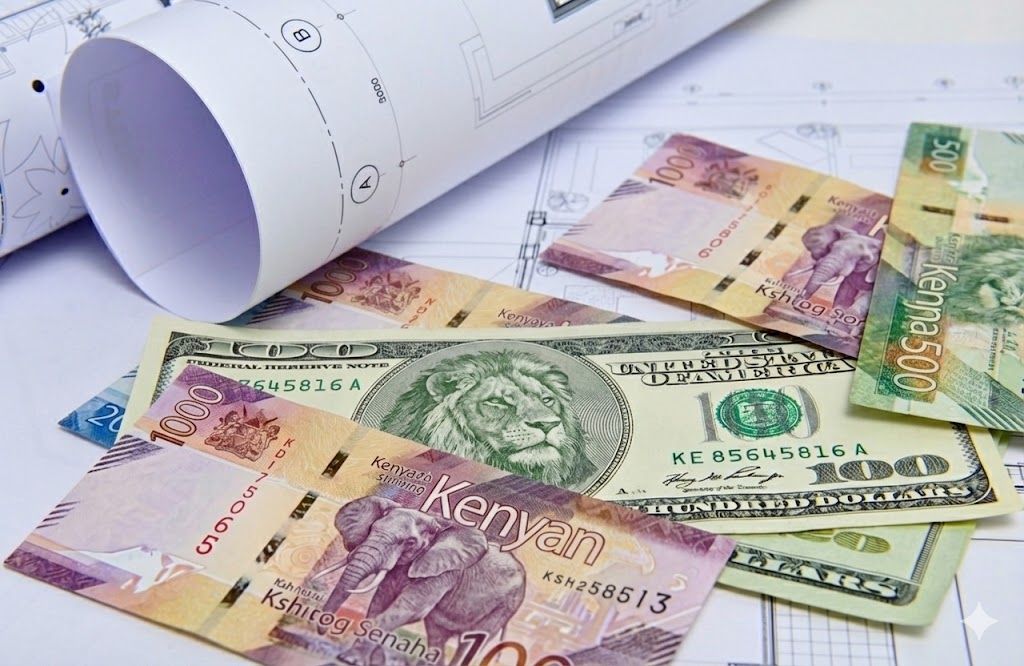
This is where people get shocked. The rate you see on the billboard is never the real cost. Banks advertise the Nominal Rate, but what you actually pay is the APR, which includes interest plus insurance, legal fees, valuation, processing fees, and taxes.
Nominal Rate vs. APR
- Nominal Rate: The advertised rate (e.g., 14%).
- APR (Annual Percentage Rate): The real cost. This includes the interest PLUS insurance, legal fees, valuation fees, and processing charges.
Hidden Costs to Budget For (add 3–8% on top of the property price)
- Legal Fees:
- 1–2% of the property value (for the lawyers)
- Stamp Duty:
- 4% in Nairobi/Mombasa,
- 2% in rural areas
- Valuation Fee:
- 0.25%–1% to confirm the property value
- Life Insurance:
- Covers your loan if you die (so family doesn’t inherit the debt)
- Fire Insurance:
- Covers the house if it’s damaged or destroyed
- Processing/Administration Fees:
- 0.5%–1% of the loan
- Excise Duty:
- 20% tax on bank transaction fees
- Ledger/Maintenance Fees:
- Small monthly/annual charges
Pro Tip: In 2025, you can claim Mortgage Interest Relief of up to KSh 300,000 per year (KSh 25,000/month) against your taxable income. This now applies to construction loans too, not just bought houses
You must budget for Construction Consultancy Fees in Kenya i.e. the Architect, Structural Engineer, and Project Manager separately, as banks often require these professionals but may not cover 100% of their upfront costs.
The Penalties You Didn’t See Coming
Aside from the upfront costs, there are also hidden fees in the contract itself.
- Early Settlement Penalty:If you try to clear your loan early, some banks charge a fee equal to 3–6 months of interest because they lose the profit they expected from you.
Tip: Ask for a mortgage with no early repayment penalty.
- Restructuring Fee:If you lose income and want to reduce your monthly payments or extend the loan period, the bank charges an administration fee to change the contract.
Tip: Confirm all restructuring costs before you sign.
Why Banks Reduce Your Loan Amount
Even if you agree to all these fees, the bank might still give you less money than you asked for. Here is why
- Forced Sale Value (FSV): Banks don’t value land at “Market Price.” They value it at the price they’d get at a quick auction (usually 20–25% below market).
- Poor Condition: Cracks, leaks, or bad workmanship lower the value.
- Title Issues: Missing beacons, unclear maps, or boundary disputes scare banks.
- Remote Location: Hard-to-access land is risky because it’s tough to resell.
- Inflated Seller Prices: If the seller is overcharging, the bank will ignore it and value the property lower.
- Weak Infrastructure: No water, drainage, or access roads reduces the bank’s confidence.
- Weak or Missing Documentation: Incomplete sale agreements, unclear ownership history, or missing approvals make the bank lower your loan or decline it altogether.
Pro Tip: If the bank’s valuation is lower than the selling price, you have to top up the difference in cash. The bank will not cover it.
Documents You Need to Apply For Mortgage in Kenya
Banks depend a lot on proper paperwork. When you prepare your construction loan requirements in Kenya ahead of time, your approval process becomes much faster and smoother.
The Basics:
- ID & KRA PIN.
- 6 months’ bank statements & Payslips.
- CRB Clearance
- Copy of Title Deed & Official Search (not older than 3 months).
If you are Building (Construction Loan), add these:
- Approved Architectural & Structural drawings.
- Valid construction permits in Kenya i.e. NEMA & NCA certificates.
- Signed Bill of Quantities (BoQ).
- Contract with your builder.
How to Get the Best Mortgage Deal in Kenya
- Check your CRB status before applying.
- Shop Around: Sacco vs. Bank Loan: Saccos often offer lower rates (10–12%) and are friendlier, but they give smaller loans (usually 3x your savings). Banks give bigger loans but at higher rates (14–17%).
- Ask for the APR: When a bank agent gives you a rate, ask, “What is the APR including all fees?
- Always negotiate the interest rate
- Bring your own lawyer and valuer if allowed
- Check loan terms before signing
- Ensure all drawings are approved
- Joint Mortgages: If you Married, Combine your payslips to qualify for a larger loan amount.
- Diaspora Mortgages: For guys living abroad, Most major banks (KCB, Equity, Co-op, ABSA) have specific Diaspora units that lend in USD or KES. They require notarized documents from your host country. Stima sacco also has a very strong “Makaazi Poa” product for the Diaspora community.
Whether you choose a construction loan, a Sacco mortgage, or the KMRC Affordable housing program, make sure you do your homework. By comparing lenders, negotiating your terms, and ensuring your documentation is perfect, you can save a lot of money…
Have a question about a specific bank or Sacco? Drop a comment below and let’s discuss!